Derivation of PV=nRT, The Equation of Ideal Gas

According to the kinetic theory of gas,

- Gases are composed of very small molecules and their number of molecules is very large.
- These molecules are elastic.
- They are negligible size compare to their container.
- Their thermal motions are random.

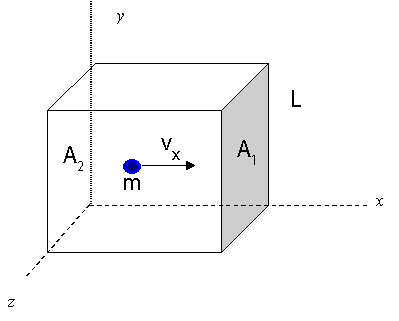
To begin, let’s visualize a rectangular box with length L, areas of ends A1 and A2. There is a single molecule with speed vx traveling left and right to the end of the box by colliding with the end walls.

3D Demonstration of Ideal Gas

3D Demonstration of Ideal Gas

The time between collisions with the wall is the distance of travel between wall collisions divided by the speed.

1. t=\frac{2L}{v_x}

The frequency of collisions with the wall in collisions per second is

2. f=\frac{1}{t}=\frac{1}{2L/v_x}=\frac{v_x}{2L}

According to Newton, force is the time rate of change of the momentum

3. F=\frac{dp}{dt}=ma

The momentum change is equal to the momentum after collision minus the momentum before collision. Since we consider the momentum after collision to be mv, the momentum before collision should be in opposite direction and therefore equal to -mv.

4. \Delta{p}=mv_x-(-mv_x)=2mv_x

The average force on the wall is equal to the momentum change per collision times the frequency of collisions.

5. \overline{F}=\Delta{p}(f)=2mv(\frac{v_x}{2L})=\frac{mv_x^2}{L}

The pressure, P, exerted by a single molecule is the average force per unit area, A. Also V=AL which is the volume of the rectangular box.

6. P_{1\:Molecule}=\frac{\overline{F}}{A}=\frac{mv_x^2}{LA}=\frac{mv_x^2}{V}

Let’s say that we have N molecules of gas traveling on the x-axis. The pressure will be

7. P_{N\:Molecules}=\frac{m}{V}(v_{x_1}^2+v_{x_2}^2+v_{x_3}^2....+v_{x_N}^2)=\sum_{a=0}^{N}\frac{mv_{x_a}^2}{V}

To simplify the situation we will take the mean square speed of N number of molecules instead of summing up individual molecules. Therefore, equation #7 will become

8. P_{N\:Particles}=\frac{Nm\overline{v_x^2}}{V}

Earlier we are trying to simplify the situation by only considering that a molecule with mass m is traveling on the x axis.  However, the real world is much more complicated than that. To make a more accurate derivation we need to account all 3 possible components of the particle’s speed, vx, vy and vz.

9. \overline{v^2}=\overline{v^2_x}+\overline{v^2_y}+\overline{v^2_z}

Since there are a large number of molecules we can assume that there are equal numbers of molecules moving in each of co-ordinate directions.

10. \overline{v^2_x}=\overline{v^2_y}=\overline{v^2_z}

Our final equation becomes

11. P=\frac{Nm\overline{v^2}}{3V}

However to simplify the equation further, we define the temperature, T, as a measure of thermal motion of gas particles. The only energy involve in this model is kinetic energy.

12. E_{kinetic}=\frac{mv^2}{2}

To combine the two equations we solve kinetic energy equation #12 for mv2

13. mv^2=2E_{kinetic}\Rightarrow\frac{mv^2}{3}=\frac{2E_{kinetic}}{3}

Since the temperature can be obtained easily with simple measurement. we will now replace the result of kinetic equation #13 with with a constant R times the temperature, T

14. RT=\frac{2E_{kinetic}}{3}

Because a molecule is too small and therefore impractical we will take the number of molecules and divide by the Avogadro’s number, NA

15. n=\frac{N}{N_a}


Sources:
1. Significant of PV=nRT
2. Kinetic Theory of Gas

Leave a Reply

You can use these XHTML tags: <a href="" title=""> <abbr title=""> <acronym title=""> <blockquote cite=""> <code> <em> <strong>